Verizon
Optimizing Verizon’s In-Store Sales Workflows
CX Design
SMB Sales
AI-Integration


Designed and led an AI-assisted iPad experience that helped Verizon sales reps deliver personalised business solutions faster - reducing in-store time and increasing sales confidence.
Role
Product Designer
Timeline
40 Weeks ,
Sept2024 -May2025
Team
4 designers, 2 sales manager, 2 AI engineers, 1 project manager
What I did
- Led user interviews with sales reps
- Created product flows
- Design system optimisation
- Usability Testing with store managers & sales reps
- Prototyping
IMPACT OF THE PROJECT
Time to Serve
52 min → 10 - 15 min
Average in-store interaction time reduced
Customer Satisfaction
NPS: 72
Improved experience for small business customers
Business Growth
+35% Sales Increase
Estimated lift in Verizon Business sales
CONTEXT & PROBLEM OVERVIEW
Verizon offers a wide range of services for small businesses - from internet and mobility to security, productivity, and collaboration tools. In retail stores, sales representatives play a critical role in helping business customers navigate these options.
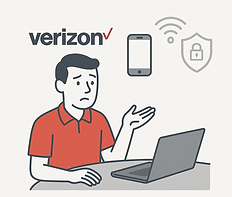
However, the in-store environment is fast-paced, and here's what we observed
-
Business customers arrived with multiple needs and high expectations
-
Discovery conversations were long and unstructured
-
Recommendations often stopped at basic internet and mobile plans
As a result:

#1 Customers left with partial solutions
#2 Sales reps felt underprepared to support business needs

#3 Verizon missed cross-selling opportunities
This revealed a core challenge:
PROBLEM STATEMENT
How might we help Verizon sales reps effectively recommend all relevant solutions to small business customers to meet their needs?
RESEARCH INSIGHTS
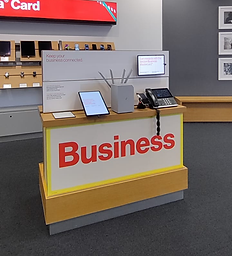
To understand why this gap existed, we went straight to the source. I conducted in-store interviews and observations with sales reps, store managers, and business customers across Verizon retail locations.
Three key insights consistently emerged:
Average length of a sales conversation in-store is 52 mins
68% of sales reps feel unprepared to support business needs

Only 1 in 4 business customers meet a Business Account Manager on their first visit
Interviewed users and observed sales reps in action at Verizon retail stores across Indiana.
RESEARCH APPROACH
To understand the pain points in the current in-store discovery experience and get first-hand insights, I interviewed and observed sales representatives, business customers, and account managers to uncover where reps were getting stuck, what information was being missed, and how business needs were slipping through the cracks.
👩🏻💻
20+ Interviews
Semi-Structured
👀
6 hours
In-store Observation

🔍
16+
Research Papers
🌐
12+
Competitive Analysis

PROJECT GOALS
With the challenges defined, I aligned around the project goals set by the client to drive impact

Reduce in-store time for customers

Increase Verizon sales

Increase cross-selling opportunities
THE PROPOSED SOLUTION
An iPad-based tool designed to support sales representatives during in-store interactions by capturing small business needs and instantly surfacing personalized service recommendations, helping reps guide conversations confidently without disrupting the human flow.
WHY IPAD EXPERIENCE?
During early research, I learned that retail sales reps already used iPads in-store
Beyond availability, an iPad made sense because it:
-
Acts as a shared surface between rep and customer
-
Enables side-by-side, collaborative conversations
-
Supports fast, touch-friendly interactions during live discussions

DEFINING DESIGN GOALS
With clear insights and patterns in hand, I translated our findings into actionable design goals.

#1 Reduce interaction time

#2 Provide guided support

#3 Preserve human connection
EXPERIENCE FLOW
The iPad experience is broken into four key phases.
Each phase is built to streamline the sales process, help reps gather the right information, and deliver personalized recommendations with confidence.

Customer Onboarding
-
Collects basic business info (name, phone, industry)
-
AI checks for existing customer records
-
Speeds up initial data entry


ADAPTING THE DESIGN SYSTEM FOR IPAD
Before finalising the designs, I expanded on Verizon’s design system to suit the iPad experience. Missing components were custom-built, and existing styles were adapted for touch interactions. A reusable component library ensured consistency and made future updates more efficient.


FROM IDEAS TO EARLY CONCEPTS
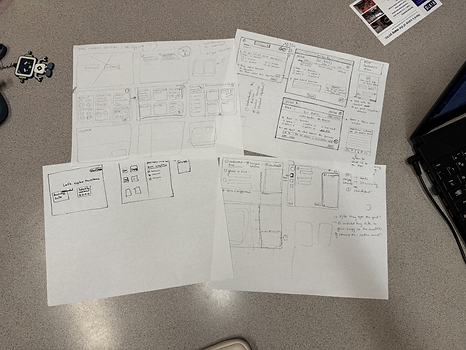
With our design goals in place, we moved into ideation phase, bringing the team together for brainstorming and sketching sessions.
I and my team began with paper wireframes to rapidly explore ideas, encouraging open collaboration and capturing diverse perspectives that helped shape a shared design direction.

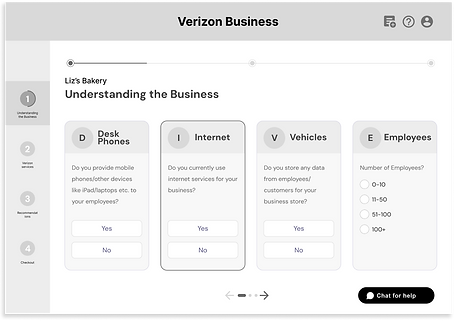
We then transitioned into low-fidelity wireframes to visualize how the tool might look and function. This helped us test early concepts, gather feedback from stakeholders, and make informed decisions, without getting lost in visual details too soon.

FINAL DESIGN

VALIDATING THE DESIGNS
To validate the solution, I led usability testing and iteration cycles with real users.
11
Think-aloud sessions
with sales and business representatives


2
Concept Testings
with Verizon Stakeholders

THIS IS WHAT USERS HAD TO SAY :)

Using this product, I can keep the conversation with customers completely natural it doesn't feel forced at all
-Sr. Director, Sales
This system is way better than what we currently have it’s more intuitive and much easier to use.
-Sales Rep, Carmel Store
What did they like?

Smooth flow that supported natural conversations
Clear service explanations
Faster handoffs through call and send-to-MSA features
What can be improved?

Updated terminology to match internal language
Added deeper follow-up questions
Refined AI suggestions for better cross-selling support
TAKEAWAYS AS A DESIGNER
-
End-to-End Product Thinking
Led the project from research through validation, balancing user needs with business goals.
-
Designing AI with a Human-First Lens
Learned how to build AI-assisted tools that enhance, not replace, human interaction.
-
Ground-Level Insight Gathering
In-store research reinforced the value of observing real-world workflows.

That's me!

Thank You! That's the team :)
